Sunday, 25 January 2009

Preparing for further study: reading


In preparation for my further study I read two books on the subject of tourism. I had already spoke about the first one I read ('Tourism in the age of globalization'), now I'd like to show which are the main points analized in the second one 'Tourism, globalization and development'.
The part that I read from this book was very interesting because it proposes not only the economic side of the touristic industry, but also a moral viewpoint. The author examines the social and environmental impact of tourism in developing and less-developed countries. Many of the poorest countries in the world rely their income on the tourist trade but developers often exclude local communities.
Donaald G. Reid argues on this problematic criticizeing developed countries and he exposes acontrolled plan for an equally development of the touristic sector.

I found very helpfull the intoduction of this book. It gives me the idea on which are the main problematics linked to tourism. Moreover I'm quite sensitive to issues regarding under-developed countries and I hope to delve a bit more into this area.

'INTERNET DETECTIVE' TUTORIAL

Doing the tutorial i understood how to evaluate the quality of web site for my reserches. Is important to use appropriate sources in accademic essays and the Internet could be a good tool or an enemy. You don't have to:
- focus your attenction only on Internet searches and ignore other sorces (jurnal articles,books on the subject)
- copy informations from the Internet
You have to:
- critycally evaluate the quality of information found on the Internet
- synthesize the information to form your own work

There is an accademic publishing process that sources should have passed to be reliable and is important to check if they have the right requirements (before based your work on them!)

Negative sides of the Internet are:
- anynone can put somenthing there and from everywhere in the world
- they can say anything they like
So is essential to know how is the writer and if he/she is an 'authority' in your subject area.
You need to question the quality and the credibility of informantion you find before you use it in your essay.
The URL on a web site can help you to understand more about the site.

Refleting writing on the Pre-sessional course and university study

I started this course two months ago and since the first day I liked the university background. I went to uni when I was in Italy and the environment is quite similar compered to this: a lot of young people running every where, trying to find the right way both in corridors and...in life. Of course there is a big difference: here in London you get in touch with people from all the world and, I think, this is a great opportunity. The theaching method is closed to the one adopted in Italy. Professors are well prepered and they give us a good preparation for the next step...the degree course.

I find this course very usefull for my personal knowledge and also to aquire the qualifications required from university. Speaking about courrent issues is very important for me to understand in which direction the world is looking. A part from that, as I said before, they teached me how to manage with the university life. For example, I wrote few essays in my country but I had difficulties to do that in English. During those months I had the possibility to improuve my writing skills and now I feel more confident.

I think I'm quite ready to contend with my degree course. I know that it may be hard especially at the beginning but it will be a good experience. The first challange will be the first formal exam and... I hope to start with the right foot!!

Friday, 23 January 2009

GLOBALIZATION LECTURE


A coplue of weeks ago with my english teacher we attented a live lecture on the subject of 'globalization'. The reader, Steve, spoke about globalization mainly from an economic point of view. He started giving us the current economic background:
- depression as bad as the last one (1931)
- banks don't have money, so the real world doesn't have money
Then he continued saying that globalization, even if it has some wonderful aspects (comunication technoligies-internet and free trade), has provided to this crisis:
- banks all around the world don't have money, because of globalization this crisis involved all countries > bank sistem is linked between all over the world
- global finance e.g. someone in China has to pay for someone else in America
- 'contagion'> is a medical term that used in an economic context means no barriers, no regolations between countries > the sickness of one country became the sickness of the world
- liquidity crisis: no money. Government started to help banks with tax money (our money!!)
- stock market: tells us that our economy is sick
- free trade > who benefits? banks and big brand companies ( e.g. Ikea, Gap...).
Unfortunately he didn't has time to conclude, but those are the other points he should has argued regarding the global impact of globalization:
- world poverty
- inequality between countries and within countries.
The solution?!? Is up to us...!!

I found this lecture very interesting. It helped me to understand how the economic world works and why nowadays we are facing this big crisis. Another thing that i liked is that the speaker used an easy, clear language.

Sunday, 18 January 2009

TOURISM IN THE AGE OF GLOBALIZATION


Globalization as a megatrend is changing the nature of international tourism:
-expansinon and diversification of travel motivations and expectation
-labour mobility (people travel to different countries to manage properties and systems)
-increse in information and communication technologies (internet: people can chose touristic destination looking at pictures and videos, last-minute offerts give the opportunity for short and cheap week-end)
-increse in travel system technology (easier acessibility of the destination)
-shopping and commercial fcilities
-multi-cultural environment (cultural differencoes between tourist and local people play an important role in the choice of a holiday destination)
-level of economic development in the destination, in paticularly if it's a under-developed country (the majority of tourist's money goes to travel agency that usually has its main office in the departure country)

Friday, 16 January 2009

Understanding plagiarism and referencing

Definition of "plagiarism": the taking and using as one's own... the thoughs, writing or invension of an other. That means pretending something is yours when it isn't, not just the words but also ideas, data and images.
There are many reasons for plagiarism:
- poor time management or planning
- carelessness with sorce information
- poor note taking skills
- incomplete referencing
Penalties for plagiarism:
- application of the mark of 0 to the whole module
- the downgranding of the award
How avoid plagiarism:
-plan ahead (don't do all the essay at last minute)
-record source detail (Books:name of author, year of publication, title of the book, name of publisher, place of publication, page reference Web-site: name of author,http:// address, date page accessed)
-take appropriate notes

Wednesday, 7 January 2009


OVERVIEW OF MY SUBJECT AREA

International Tourism Management

Today tourism is probably the industry which can avail itself of the greatest number of possibilites for expansion, both on a national and international level.
Tourism is able to contribute to development which is economically, ecologically and socially sustainable, because it:
  • has less impact on natural resources and the evironment than most other industries
  • is based on enjoinment and appreciation of local culture,built heritage and natural environment as such the industry has a direct interest to protect those assets
  • can play a positive part in increasing consumer commitment to support underdeveloped countries
  • provides an economic incentive to conserve natural environments and habitats which might be otherwise damage by an unconscientious land uses (maintain bio-diversity)

Friday, 5 December 2008

LIBRARY RESOURCES FOR WRITTEN PREPARARTION

  • Increased use of science and thecnology to fight crime invades personal privacy
  • United Kingdom is the most controled nation in the world
  • London: 4 million CCTV, you are captured on camera approximately 300 times a day (Big Brother Society)
  • CCTV -people feel unconfortable watched -no way to interact with who control our pictures -invasion of public space -big coast for society -reduce the possibility of a genuine civilizationt
  • Internet: individual database (authorities have acsess to informations we search on internet -they enter in our house) -is used from managers to controll either employer's private life and work
  • Other thecnologies that invade privacy: -oystercard (control our displacement) -microchips (installed in people or rental car) -RFID (installed in products that we buy to know people's shopping habits)
  • Everyone is considered a potential criminal
  • Surveillance is a big business (300 millions of pounds spent only for cctv)
  • There is no balance between surveillance and people privacy -Are we ready to renounce to our privacy living in the hopness that this advanced thecnologies will help in the fight against crime in a concrete way?

Wednesday, 3 December 2008

Tuesday, 2 December 2008

SPEAKING PRACTICE
Last week I was planing to attend a discussion class in the afternoon, but, in fact, was not what I was waiting for. We went to a language laboratory in the university and then, the teacher (I don't remember his name..), told us that we were going to prepare a presentation about "acid rain". We had 25 minutes to prepare our speech using some audio/video and written documents. The teacher came back and we had to expose our presentation recording it on a small camera. It has been a complete desaster for me! While I was reading the document and whatching the video, I was thinking that was not so difficult: I already knew the meaning of most of the words used and I also knew,more or less, the acid rain process...but when I turned on my camera, after maybe the first two sentences, I get completely lost even if I had my notes in front of me. What does it mean? I think that in my head, in my mind I know the meaning of lots of words in English, so either when I hear or read them I don't find any difficult to understand, but when I have to build a sentence those words don't came out! What can I do? I have to put more attencion in reading and listening, trying to "keep" what I know already. In addition I should speack more English, about everything, to make the passage from thinking to speacking more fluid.


Glastonrbury festival 2007. Britain's largest outdoor music festival.

PREPARING FOR FURTHER STUDY: READING


"THE ESSENTIAL LEGAL GUIDE TO EVENTS" by David Becker


The author of this book is an internationally qualified loyer specialised in the entertainment industry and the aim of his written-work is to assist event professionals, giving to them an easy-to-read guide for the most important legal issues connected to the organisation of an event. Granded that the events industry has a number of different laws that could vary from country to country, David Becker wants to share his experience with us describing which are key deal terms for a range of basic, simple contracts. It should be noted that this book focus the attenction to law in tha United Kingdom, United States and South Africa.
THE EVENT: there is no strictly definition for the word "event", it's just an occasion that people have to share something; there are varied fields because that could happen: culture, charity, sport, business, politic or recreational purpose. An event is somenthing unique, one it has started there are no second chances. No one can predict how it will be, but organiser can plan and prepare everything carefully in order to make a success. Nowdays events industry is a massive and fast-growing one, because of this every event need to be memorable and faultless. There are lots of horror stories about disputes with event organisers (sponsors, caterers, promoters...); this is a risky area that's why written contracs are essantial, they help to deal with the risk.

I found really interesting to read the introduction of this book and i have to say that the language used from the author is clear and simple, even if he uses some thecnical terms, i didn't have any problem to understand the main meaning. It also gave me the starting point for some reflections about my future study's subject, increasing my thirst of kwnoledge. I could imagine that to give life to an event you have to face some risks, but now i know that there are some laws to protect youself. I consider this lecture as the first step on the organisation of an event... (mybe my next birthday party!!)

Monday, 1 December 2008


LONDON VISIT


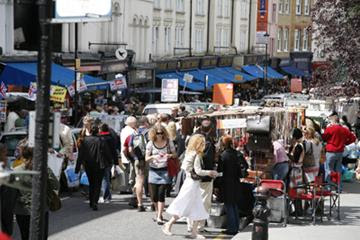
London, London, London....maybe one of the most notorious place for shopping in the world. Regent, Carnaby, Bond and New Bond Streets are always full of hordes of people walking up and down the roads, looking at big brand' s shoop-windows like Yves Saint Lauren, Gucci or Adidas...but, I think, there is an other side of this metropolis that, in a different way, can satisfy this thirst for shopping, I' m talking about Markets. I would like to suggest you to visit one of those: Portobello, Spitalfiels, Camden or Borough market.


PORTOBELLO MARKET

Located in one of the most beatiful area of London, Portobello Road goes staight through the heart of Notting Hill. There are several different sections in this market; you can find antiques, food (in particulary vegetables and fruits) and fashion. It takes place only on saturday and generally is full of people.
SPITALFIELDS MARKET
Close to Liverpool St tube station, you have the chance to escape from the cloned high street and be bone up on a creative, colorful world. Artistic people go there to express themself with clothes, accessories, jowels, paintings... that are, in most of cases, hand-made. Walking around the different stends you can feel the atmosphere full of life and music! This market is open from thursday to sunday that is the busyest day.
CAMDEN MARKET
This is the most popular open-air market in London, situated in North-West. It' s a sea of entretainment, streets are populated by exravagant people, stands are full of strange things, every kind of things... Even the setting is amazing, with its canal flowing in the middle. After 10 o'clock pm, when the market finishes, the night life starts: pubs, theatres, clubs and restaurant open the door end then....you have to go there to see what happens!
BOROUGH MARKET
It is the London's oldest food market, born on the south bank of the Thames 250 years ago. Traders don't want to broke the tradition of genuine food, they believe that everyone has a right to eat well, that's why there you can buy genuine, excellent aliments. Maybe just for curiosity or maybe plod by the idea of a great dinner, you have to go there.

Saturday, 29 November 2008

WATCH A TV DISCUSSION SHOW

-
www.bbc.co.uk/iplayer/episode/b00g15rt/Click_29_11_2008


While i was looking for something to watch on the bbc website, a link catched my attention "Dan Simmons witnesses the VIRTUAL REBIRTH of Berlin and London". In this programme they spoke about a kind of virtual life that take place on the web: a copy of yourself goes around into a virtual word doing what you don't have the courage or the opportunite to do in reality. Let's go into detail... You have a perfect reconstrucion of the city, in this case Berlin, and your virtual-self can wander around: walk on the street, go shopping or have a drink in pubs and discos that exist in the authentic Berlin. Even the social environment is developed: there are a lot of people that,like you, have created our own character and you have the possibility to talk with them. In other worlds, a person who lives for example in London can rebirth in Berlin, buy a house and found relations without moving from a chair! Jochen Hummel, one of the co-funder of this progect, shows how take advantages of an online world: it's a way to explor new places, it's good for shopping, work collaboration, dates and education. He also add that, entering in this world, you are not escaping from your real life. After the end of this video I spent 10 minutes thinking how would be my virtual-self, my copy... and, to be honest with you, I'm really bewildered about this surreal word. In my opinion this is a prove that we are not able to build direct relationship, computer and thecnology take the place of the self and the language- the art of speaking. The internet is an irreplaceable facility to do a lot of things but it can't replace the concrete life. We are human, made of blood and flesh, we prove emotions and we have our eyes to look at the reality or in someone else's eyes.. How a computer screen and a keyboard could replace this? There is no way. Having said that, I would like to encourage people to find their place into the true world before start a "parallel existence" in the web one.

Monday, 24 November 2008

This morning we had a seminar on the subject of the media/television.
In my group there were people from different parts of the world: China, Lithuania, Vietnam and Arabic countries. We spent almost one hour talking about television viewing habits in our countries and was quite interesting to descover that, even if each country has an own policy to manage television broadcasting, all of us had the same ideas on which are the main problems linked to TV.
At the end it came out that television has changed a lot in the last 20 year and, unfortunately going to the bad. Nowadays people watch too much TV trying to escape from reality so TV producer ground on an "Ideal Life" their programmes. Stereotypes are integral part in the TV background used to make clear to viewers the differences between each character, for example "the rich man" with a professional job or "the single woman" looking for a relationship.
An other important point in our discussion has been "Media Literacy" and the joint agreement was that people should better understand the power of television to don't let it to corrupt their mind.
I enjoed this seminar; in my group everyone had the possibility to speak and i didn't have any problem to understand every single point of view, maybe because, as I said before, they were quite similar.
Besides, I found really useful to get myself informed about the seminar subject, firstly because it made me feel more secure when i was speaking and secondly for my personal knowledge, seeing that media and television are two topical issues.

Saturday, 22 November 2008

Friday, 21 November 2008

About me...

I'm a 21 year old girl who comes from a small town in the hart of Italy.

I've been living in london since one year and from my eighteen since now, is the longest time i remained in the same place...said the you can deduce that i really like London!
Last year when i arrived i found a job almost immediatly in one of the clothes store of the "Massimo Dutti" chain. Was a great experience: I met a lot of interesting people and I could improve my English that becames good enough to express myself in a clear way.
You have to know that I'm a person who likes take personal challenges to enrich her knowledge so, when the working environment becames boring, I decide was the right time to change.
Universitary background always actracted me so...here I am!Ok, to be honest was not so easy, you know, you have to apply on time and do all the bureaucracy part and then you have to wait for the response and...if it's positive you have to pay!Anyway, at the moment I'm attending the
pre-sessional Academic English programme and I'll be ready to start my degree course in February.
I'm a girl who wants to know as much as possible about the world, about people who lives in there; I love music, i think is the best way to enjoy my life, I like sports, I love travels, books and nature...I love everythink makes me feel alive, everything which gives me an emotion.
That's who I am, what I like, and why I choosed to study "Events Management" linked to "International Tourism Management".
I hope, one day, to work in the tourism sector to increase people to travel coscientiously,having a great time getting in touch with new cultures. I wish ,one day, to aquire the ability and skills to create anything wich involves people who are enthusiastic and passionate about what they are seeing.
I think that for the moment you know enough about me....

Ultimate spaghetti carbonara

Ingredients:

  • 100 gr pancetta
  • 50 gr pecorino cheese
  • 50 gr parmesan
  • 3 eggs
  • 350 gr of spaghetti (de cecco are the best)
  • 2 plump garlic cloves peeled
  • 50 gr of butter
  • salt and greated black pepper

Method:

  1. Put a large saucepan of wather on boil.Chop the pancetta.Grate both cheese and mix them together.Beat the eggs in a bowl and add a tach of black pepper.Set everything a side.
  2. Add salt to boiling water,add the spaghetti and cook at a constant simmer for 10 minutes or untill "al dente"
  3. While the spaghetti is cooking,fry the pancetta whit garlic.Drop the butter into a frying pan and as soon as has melted,add to the pancetta and garlic.Leve those to cook for about 5 min,untill the pancetta is golden and crispy and then take off the garlic.
  4. When the pasta is ready lift it from the water with a pasta fork and put it in the frying pan with the pancetta.
  5. Mix most of the cheese with the eggs,kiping a small handfull back.Take tha pan of spaghetti and pancetta off the heat .Now quikly pour in the eggs and cheese,using a long fork lift up the spaghetti so it mixes easily with the eggs mixture,and everything is coated.
  6. Serve immediatly with a little sprinkling of the remain cheese and a gratting of black pepper.

Followers